On this page
A researcher is revising a methods section after a review meeting. The team's evidence is scattered across a paper library, meeting notes, a draft document, and an email thread about why one analysis was excluded. The immediate request sounds modest: explain the current inclusion criteria and identify which decisions still need a source.
A general-purpose AI can help with that task. But without the history, the first task is usually to reconstruct the history. The researcher searches for the relevant note, copies passages into the chat, explains which draft is current, and warns the assistant not to treat the older plan as the final protocol.
The problem is not primarily the quality of the model's prose. It is the cost of rebuilding a working picture of the project each time the model is asked to contribute.
Before: the conversation begins with reconstruction
Imagine that the review meeting ended with three decisions. The team kept one inclusion criterion, narrowed another, and postponed a third pending an additional check. Those decisions live in separate places: the agenda says what was proposed, the meeting note says what was agreed, and the latest draft shows what was actually changed.
The researcher asks an assistant to write a short summary. It responds reasonably to the excerpts supplied. Yet an omitted note can change the conclusion. A polished paragraph can still describe yesterday's plan.
To prevent that, the researcher becomes the retrieval system: opening tabs, selecting passages, clarifying chronology, and checking whether the answer quietly blends a proposal with a decision. When the work shifts from a chat assistant to a writing or coding tool, the explanation has to be repeated.
That is a common structural weakness of stateless workflows, not a reason to assume the assistant can infer missing facts. If the evidence was never supplied, a fluent answer does not make it present.
After: context is available at the point of work
In this case, the researcher connects supported sources and authorizes one AI integration to retrieve relevant information. The context system maintains project relationships: which draft belongs to which study, which meeting preceded the revision, and which message contains the rationale for the exclusion.
The researcher asks: "Draft the current inclusion criteria, and show me where each change came from. Mark anything that remains uncertain."
Instead of a large pasted dossier, the assistant requests the active study's permitted context and source links. The discussion begins with the current decision and the evidence behind it.
A good response would distinguish the agreed criterion from the proposed one, cite the meeting note that records the decision, and flag the unresolved check. The researcher would then open the original sources before accepting the wording. If an email and a draft conflict, the answer should surface the conflict rather than choose whichever text looks newer.
The assistant has not become an authority on the study. It has become better positioned to help the researcher inspect the evidence already assembled.
The workflow, at a glance
| Without shared context | With selected project context |
|---|---|
| Find meeting notes → copy excerpts → explain previous decisions → request synthesis | Authorize relevant sources → retrieve project context → draft with source links → verify claims |
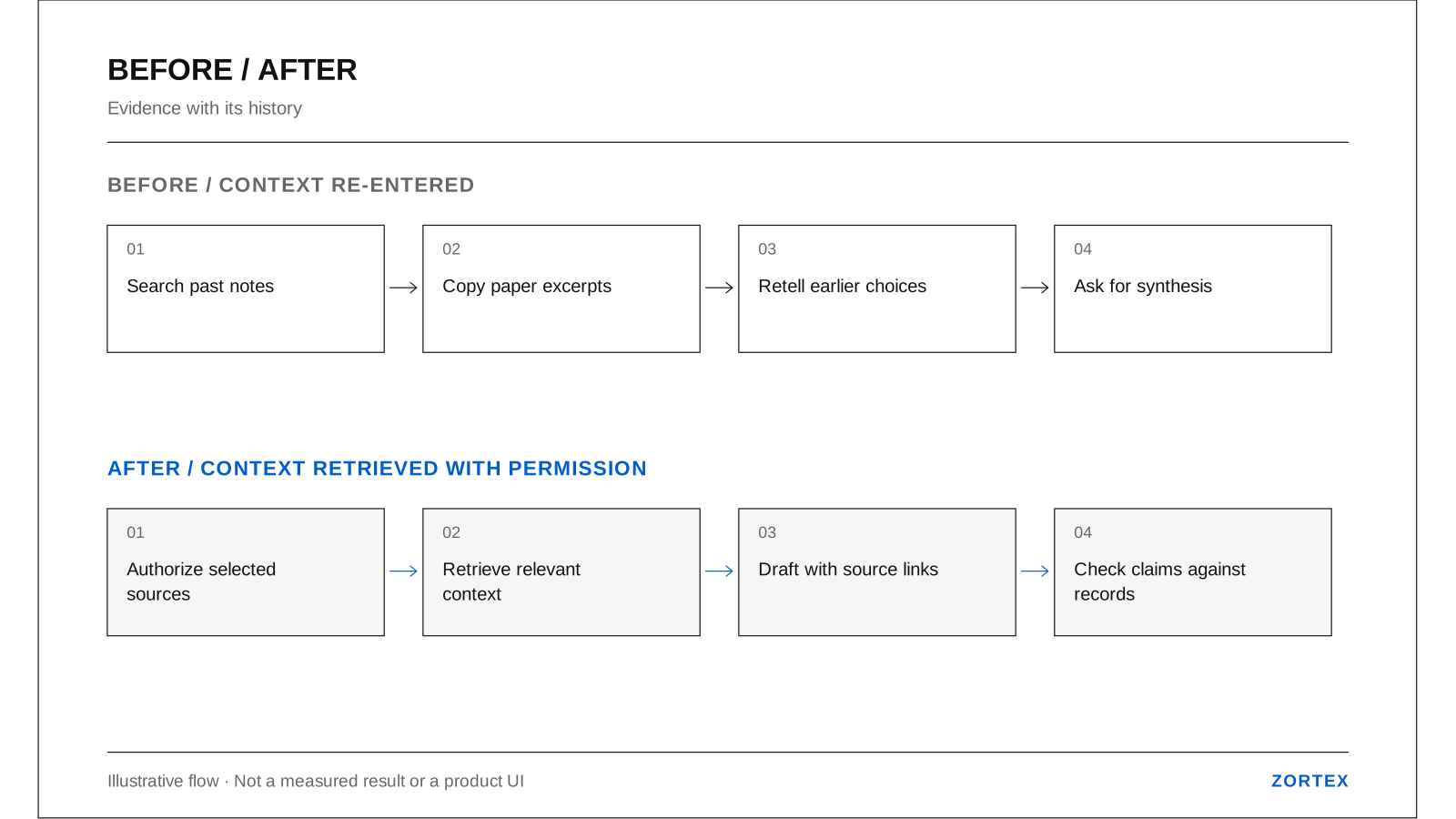
The same methods question with manual and source-linked context gathering.
What actually changes
The first difference is where the effort goes. In the earlier workflow, the researcher spends attention assembling the inputs for the model. In the contextual workflow, more of that attention can be spent judging whether the model selected the right evidence and interpreted it correctly.
The second is continuity across tools. The same project history could inform a chat discussion about methodology and a later coding question about a dataset, provided each integration has the necessary permission. It should not require copying the whole conversation history from one assistant into the next.
The third is the ability to preserve distinctions that a pasted summary often loses. A project has provisional suggestions, approved decisions, abandoned experiments, and pending questions. Treating these as different kinds of information matters more than generating a longer memory of the project.
None of this guarantees a correct answer. The retrieval system can miss a document, a note can be wrong, and two collaborators can disagree about what a meeting resolved. Source links are a means of checking, not a substitute for checking. An assistant that cannot locate evidence should say so rather than quietly fill the gap.
Where the boundary sits
The workflow depends on sources the researcher has chosen to connect and on the capabilities and grants of the selected AI. A file outside those sources should not appear simply because it is relevant. A grant to help write a methods summary is not permission to send messages, edit the protocol, or release private study information.
Local-first storage also does not mean every AI request stays local. If a connected assistant runs on a cloud provider, the selected context returned to that assistant may be processed by the provider. The researcher would need to understand that boundary before using confidential or unpublished material. Connecting a source, granting an AI access, and approving an action are separate decisions.
Zortex Version 2 organizes context for authorized AI tools. The Version 2 page lists access and supported connection requirements. The account follows one methods-revision task using that architecture.
The measure of success
The useful check is source traceability: can the researcher locate the original record, identify an unresolved decision and correct an error without reconstructing the project?
The important moment comes after the draft arrives: the researcher recognizes the source, corrects a qualification and returns to the methods section. The AI provides access to the working evidence; it does not make the methodological decision.