
On 31 May 1669, Samuel Pepys reached the end of his diary. He had kept it for more than nine years, recording the plague, the Great Fire of London, the business of the navy, arguments at home, gossip, entertainments, and acts he was not proud of. His eyesight had made the work difficult. He feared that continuing to write would injure it further.
He considered a replacement: let other people keep the journal in ordinary handwriting. Then he noticed that the replacement would change what he could write. If his people took down the account, it would have to contain only what was fit for them, and perhaps the world, to know. He proposed keeping a margin in the book where he might still add notes himself in shorthand.
The passage is preserved in the Pepys Library's account of his final entry. Pepys was describing a practical problem with his eyes and his pen. Within it is a second problem: the presence of an audience changes the material before the first word has been written.
A person can tell a secretary what happened at a meeting. The same person may record, on an unshared page, what they suspected during the meeting, which explanation they almost gave, and which colleague they privately mistrusted before learning more. The secretary may be scrupulous and kind. The distinction remains.
It matters that Pepys did not propose burning the diary or abandoning the record. He wanted to keep writing. He wanted a smaller space inside the public account where an unfinished or embarrassing observation could still be set down in his own hand.
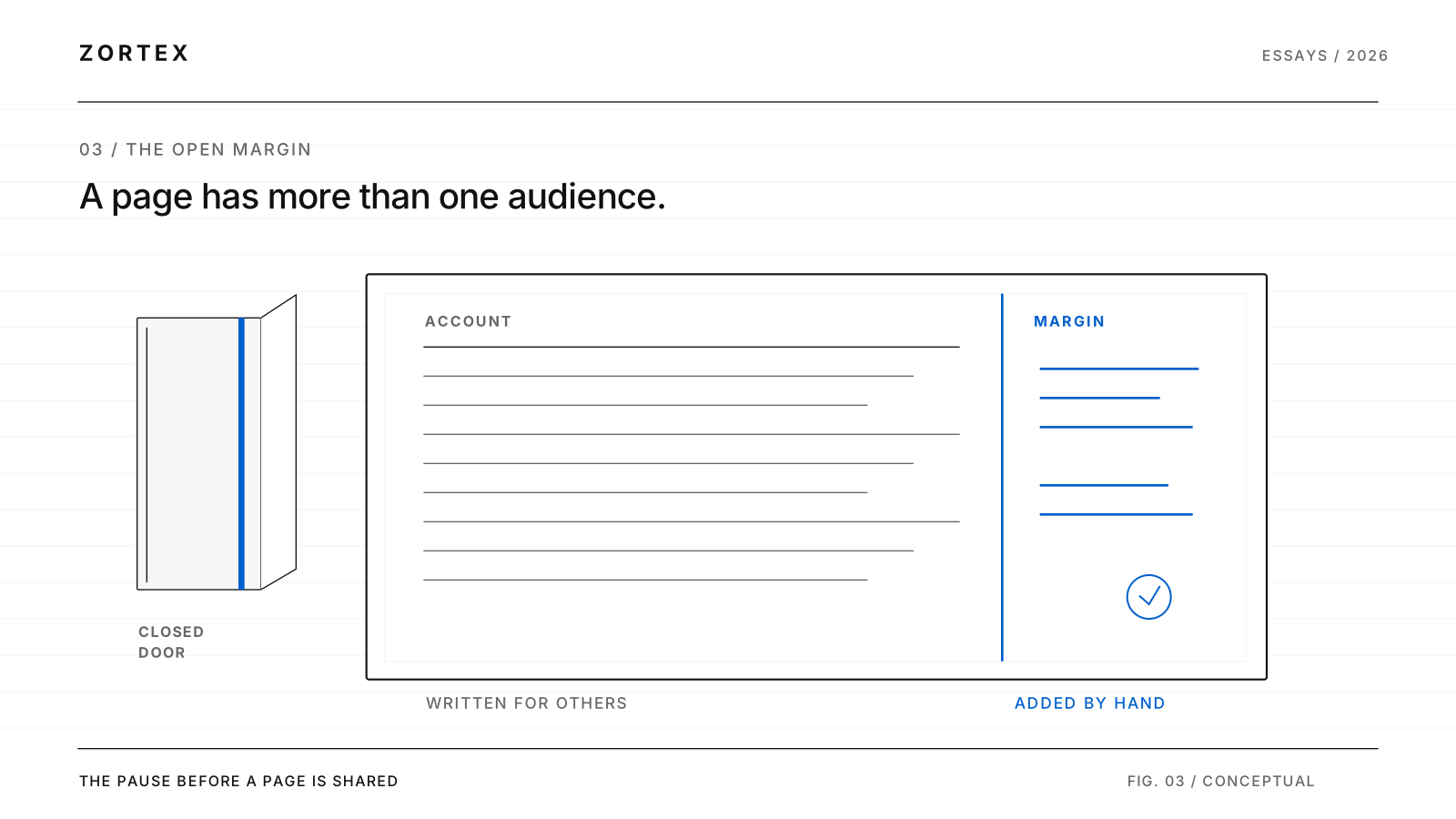
A private margin beside an account that other people may read.
A diary often contains sentences whose first audience is the writer. Some diarists write for publication; others write as though the book will never be read. Pepys's later readers can see a life because his pages survived. But while he was making them, he used a method of writing that let him keep some distance between the event and its account to other people. The margin was a modest piece of that distance.
The distance is familiar even to people who have never kept a diary. Someone drafts an email and deletes the first paragraph. A student rehearses a disagreement alone before saying it aloud in class. A manager writes two possible explanations for a failed project and spends an evening deciding which is supported. The discarded paragraph, the rehearsal, and the bad explanation are part of the work of deciding. They are not all equal candidates for circulation.
A closed door performs a related service. It does not make what happens inside wise or virtuous. It makes a different kind of behavior possible. In an open office, a difficult question may be postponed because the speaker cannot bear to put it to an audience. Behind a door, the question can be asked badly, then again more accurately. Other people will hear the finished version later, if there is one.
The door also permits things that ought to be challenged. Harm can be planned out of sight. A private conversation can become an excuse for evading accountability. That is why ordinary life has doors and also procedures for entering them: consent, obligation, warrants, professional duties, emergencies. A boundary need not be absolute to have a purpose. It has to be real enough that entry calls for a reason.
In 1890, Samuel Warren and Louis Brandeis published an essay in the Harvard Law Review concerned with new methods of exposing personal life. Newspapers had become more aggressive; photography made details of daily life easier to reproduce. Their argument, The Right to Privacy, asked why the law should protect a home from physical intrusion while leaving some forms of personal exposure to the curiosity of outsiders.
The technology in that essay now looks slow. A photograph had to be taken. A story had to be printed. Someone had to carry or read the result. Yet their subject was not only the movement of information. They understood that being made visible could injure a person even when no money or object had been stolen.
A room can be entered without taking the furniture. A thought can be displayed without removing it from the writer's possession. The object stays where it was; the relationship between the person and everyone who has seen it does not.
Nearly forty years later, Virginia Woolf approached a different door. In A Room of One's Own, published in 1929, she described the material conditions required for women to write: money, time, a place where interruption would not determine every sentence. The British Library's account of the book stresses that her room was not simply a metaphor. Rent and income mattered. A key is less useful when somebody else controls the house, the day's labor, or the money to remain there.
It would flatten Woolf's argument to turn the room into a general slogan about keeping secrets. Her question was who could make literature under the conditions then available. The room allowed sustained work. Its door was only one part of the arrangement.
We can find the same practical point in smaller things. A reader folds a letter before replying. A musician closes a practice-room door to play the same passage incorrectly for an hour. A child makes drawings that nobody is asked to grade. The child may later show one drawing and keep another. The two choices need not be explained.
Now imagine that the room contains a device which can read every draft, hear every rehearsal, remember every hesitation, and summarize all of them for anyone with the right account. Its memory might be extraordinarily useful. It could find the lost version of a paragraph, connect a note to a meeting, or remind the musician why the third movement is difficult. It could also erase the working distinction between trying a sentence and adopting it.
This is a present problem for personal AI. The records available to a system may include sent messages and unsent drafts, finished documents and rough notes, work calendars and family plans. An assistant asked to prepare a public summary might draw on all of them if the access boundary does not tell it otherwise. Its summary would be fluent. The person described by it might recognize phrases they had never chosen to say.
The error can begin before any information leaves the computer. If the model treats a private doubt as an established belief, later answers may be shaded by a conclusion the person never reached. An assistant may remember the first angry draft rather than the email that was actually sent. Correcting the record can require more than deleting the draft; the inference may already have spread through other descriptions.
Some people will want an assistant to remember more. They may prefer that an old notebook remain searchable for decades. Others will need a narrower interval: this project, this afternoon, these sources, this question. Neither preference should have to be justified by a performance of innocence. People differ in the amount of audience they want during the making of a thought.
The difficult engineering work is in the boundary between the record and the answer. A local store can keep original sources close to their owner. A permission check can limit what a particular assistant receives. Provenance can show whether an assertion came from a sent email or from an unsent note. Removal can stop a stale association from being presented again. Each measure is partial. A copied passage cannot always be retrieved from a recipient, and a label cannot prevent every mistaken inference.
Zortex's application privacy policy makes that limit explicit: connected data can be synchronized locally, while permitted results sent to a separately connected cloud assistant may be processed elsewhere. Disconnecting the source does not erase copies held by that provider. The boundary has to be considered at the moment of disclosure, not imagined backward after the fact.
The history is not a chain of identical arguments. Pepys had the problem of dictation; Warren and Brandeis confronted print and photography; Woolf wrote about the conditions of intellectual work. A modern assistant introduces its own mechanisms and obligations. The resemblance lies in a small interval that can be difficult to keep when another observer enters too early.
A diary has pages. A room has a door. A software system has grants, interfaces, storage and logs. None is good simply because it can be closed. What matters is whether a person can tell when it is open, who has entered, and what was carried out.
Pepys's proposed margin is easy to overlook. It was not another book or a second room. It was a narrow strip beside a version of his life that other people might take down. He planned to leave it blank until there was something he still wished to write by himself.