
On this page
A student is working on a lab report, helping with a group presentation, and organizing a student club event. None of these projects is especially complicated in isolation. Together they produce a familiar coordination problem: deadlines are in one calendar, group decisions are in messages, supporting documents are in shared folders, and personal notes explain why a particular plan was chosen.
On Sunday evening, the student wants to make a realistic plan for the week. A generic assistant can suggest time blocking, task ranking, and a sensible order for assignments. What it cannot do without context is know which lab analysis is unfinished, which presentation slides the group reassigned, or which event materials need review before a meeting.
The student could explain all of that. But doing so requires making a plan before asking the assistant to help make a plan.
Before: several accurate lists, no single picture
The student checks the course portal and copies the due date into a note. A message from the group changes the presentation sequence. The lab's shared file still has a draft title, while a private checklist holds the current analysis steps. The club calendar has a rehearsal overlapping with a study session.
Each source is accurate for part of the work. None tells the whole story. The student asks the assistant, "What should I do first?" and receives a general answer: work on the earliest deadline, break large tasks into smaller ones, leave a buffer. That advice is not wrong, but it does not resolve whether the lab report depends on a teammate's data or whether the group presentation is already complete enough to rehearse.
The student then spends time copying details between systems and correcting the assistant's assumptions. After opening another AI tool to outline the report, the student explains the project context again. The information is available somewhere, but it is not conveniently available at the moment of the question.
After: the plan begins with relevant commitments
In this case, the student connects permitted calendar, file and message sources to a personal context engine. A weekly-planning assistant receives the relevant projects, while unrelated private material stays outside its grant.
The question becomes: "Use the commitments I have already recorded. Show the dependencies and conflicts for this week. Don't invent due dates, and mark anything you cannot verify."
The assistant brings together the lab deadline, slide ownership and club event details. Its schedule separates tasks ready to begin from work blocked by another person and records the source for each date and dependency.
Suppose it notices that the proposed rehearsal overlaps with the student's allocated lab time. The useful response is not a silent calendar edit. It is a visible conflict with options: move the personal study block, ask the group whether the rehearsal can shift, or change the sequence of preparation. The student chooses the response.
The plan retains source references for deadlines and flags tentative events, outdated files and ambiguous group messages for confirmation against course requirements.
The workflow, at a glance
| Without shared context | With selected project context |
|---|---|
| Check calendars → search files and messages → re-enter deadlines → build a plan | Choose relevant sources → review obligations → draft a weekly plan → verify dates and dependencies |
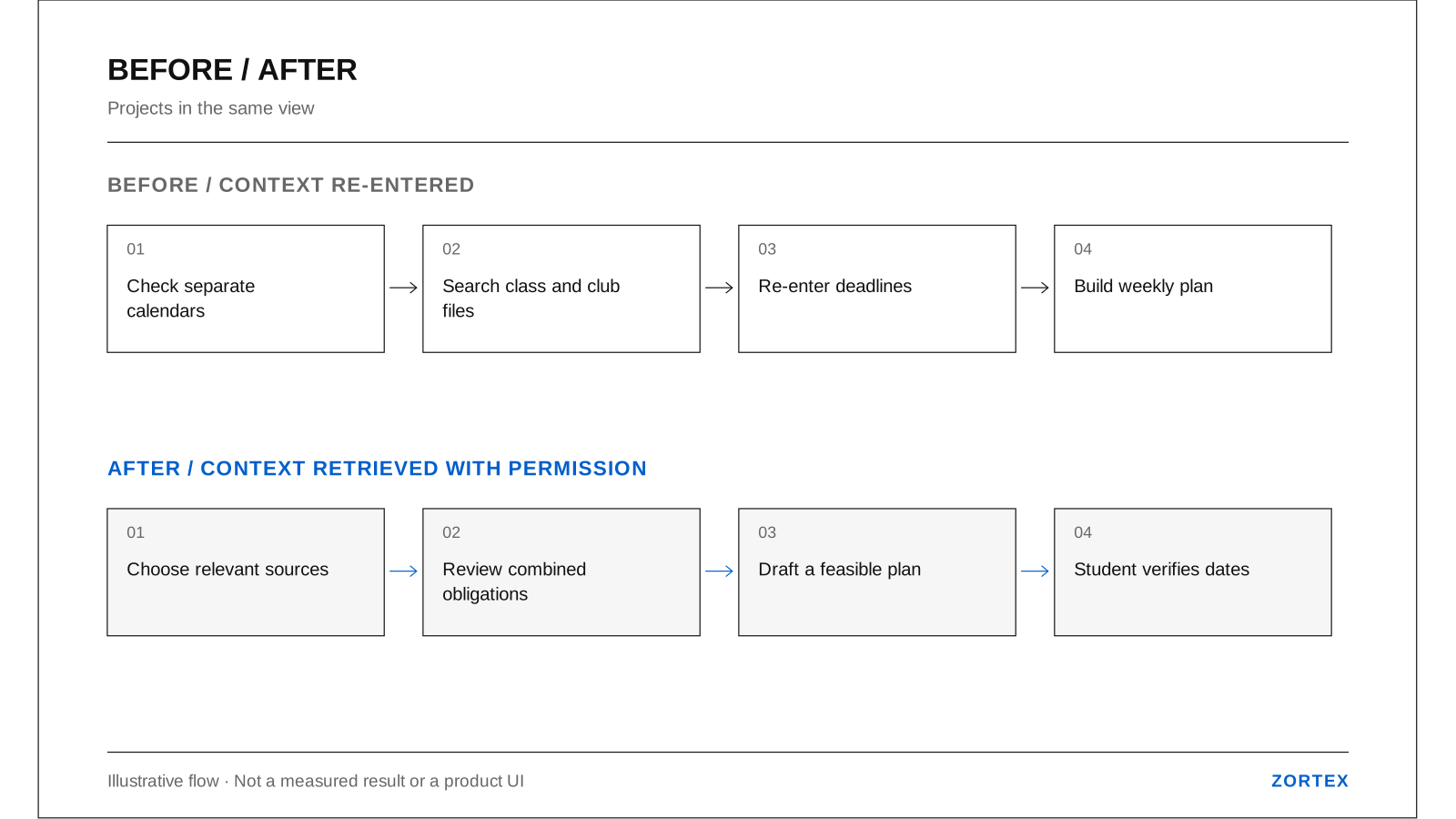
Two planning workflows: manually recapping sources and reviewing source-linked commitments.
A plan that respects different kinds of work
The student has three distinct obligations. The lab report demands sustained individual attention. The presentation depends on coordination. The club event has an external time that cannot be moved by rearranging a to-do list. Treating all three as generic tasks obscures the reason they conflict.
A context-aware view can preserve those distinctions. It can show that the lab needs a specific source file, that a slide change depends on a teammate, and that an event booking creates a fixed constraint. That makes it easier for the student to allocate effort without repeatedly translating everything into a new chat message.
There is also a continuity question. The student may use one AI to plan the week, another to review a report outline, and a third to work on a presentation. The same underlying personal context could reduce repeated explanation across those conversations, subject to the permissions given to each integration. The report assistant does not need access to the student's private club conversations simply because the planner used them.
The aim is not to encourage automatic completion of schoolwork. An assistant can help surface sources, explain a plan, or point out missing prerequisites while the student remains responsible for understanding the course material and following academic-integrity rules. A coherent schedule is useful only if it supports the student's own work.
The permission boundary
Zortex's context engine is organized around a local-first store and per-AI access decisions. The Version 2 page lists desktop access and connection requirements; the plan follows the product's per-AI permission boundaries.
There is a privacy boundary as well. If a connected AI uses a remote model, permitted snippets sent to that AI may leave the student's device. Some group documents also belong to other people or institutions. Technical access should not be confused with permission to share, and a student should be able to keep sensitive sources outside the assistant's view.
A useful plan links deadlines to source records, surfaces conflicting entries and remains easy for the student to explain and revise.
The work remains human
At the end of Sunday, the student has a schedule supported by sources, one visible conflict and a few questions for teammates. The plan organizes existing obligations without making the choices for the student.
The student spends less time repeating obligations and more time prioritizing the work.