On this page
A small-team founder needs to decide whether to move a release date. The engineering discussion is in messages. A customer-facing promise is in email. The current plan lives in a shared document, and the reason for the original deadline sits in notes from a meeting two weeks earlier.
The founder could ask an AI to draft the decision memo. The difficulty is that the memo must account for what the team has already promised, not just what sounds sensible in isolation.
In a company with few people, there may be no designated person maintaining a clean institutional history. Every participant remembers a different piece. The founder often serves as the bridge between the tools: copying context from one place, explaining exceptions, and reminding the assistant that a decision was made after the document it found was written.
Before: a capable assistant with an incomplete picture
The founder opens a chat and asks for release options. The assistant suggests shipping on time with reduced scope, delaying the release, or staging the rollout. These are plausible options. They are also the options almost any team might receive.
What the assistant cannot know from the prompt is that one customer has been offered early access, a dependency was deliberately deferred, and a teammate has already proposed an alternative sequence. The founder must retrieve those details, paste them into the conversation, and restart the analysis.
The work is not only clerical. It includes interpreting which message represents a commitment, deciding whether a meeting note still applies, and finding where the risk was acknowledged. If the founder skips a source, the assistant may confidently optimize for a constraint that no longer exists.
Switching from chat to a coding tool or a document editor creates another discontinuity. Even when the tools are individually useful, they do not automatically share the same understanding of why the team chose this plan.
After: start with the team's actual constraints
In this case, the founder connects permitted email, calendar and document sources to a personal context engine. The chosen assistant retrieves project information within its grant. The founder asks a more specific question: "What changed since we committed to this release, and what are the defensible choices now?"
The assistant brings together the current plan, earlier decision note and relevant correspondence. Its memo distinguishes commitments made externally, internal preferences and open assumptions, with links to the underlying records.
The founder sees that one option would require a customer update, while another would preserve the external commitment but narrow the internal goal. The draft does not make that trade-off disappear. It puts the trade-off where the founder can inspect it.
There is no automatic authority to announce a delay, change the roadmap, or send an email. Those are actions with consequences. A proposal and an executed action should remain distinct, and the founder should approve any message or change before it is made.
The workflow, at a glance
| Without shared context | With selected team context |
|---|---|
| Search threads → combine documents → retell earlier trade-offs → draft the memo | Permit relevant access → retrieve decisions → draft options and risks → confirm the next step |
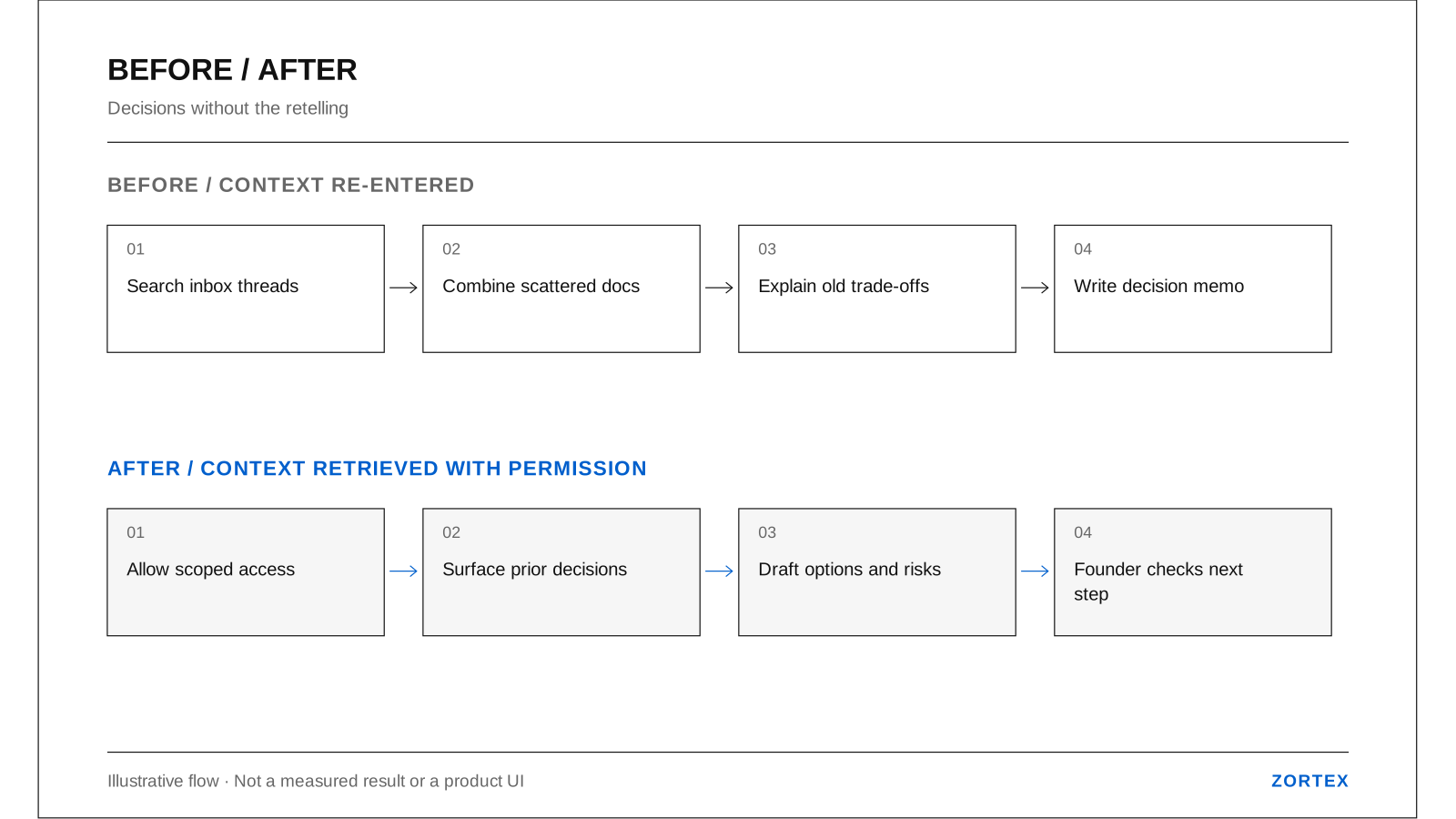
Two ways of assembling the same release decision.
What the founder gains, and what remains theirs
The practical change is not that the founder stops being responsible for decisions. It is that the assistant has a route to the decisions' origins. A short memo can point back to the source that established a deadline or the conversation that exposed a dependency. When someone asks why a plan changed, the answer does not need to depend on the founder's memory alone.
There is also a more subtle benefit: a better question. Without context, the founder asks for generic release advice. With selected context, the founder can ask the assistant to identify contradictions between the plan, commitments, and latest status. That still requires judgment, but the judgment can begin with actual records rather than an invented average team.
A sensible memo would distinguish evidence from inference. "The team agreed to delay the integration" needs an attributable record. "That delay may reduce launch risk" is an assessment, not a recorded fact. If the available sources do not establish a claim, the assistant should mark it as an assumption.
The memo gives the founder a source for each commitment and a visible place for disputed assumptions. That is the concrete advantage of gathering project records before drafting options.
Trust is part of the workflow
A founder's connected systems contain information about employees and customers, not just the founder. A request about the release does not justify sweeping access to payroll, personal messages, or unrelated projects. Permissions should be limited to the AI and task that need them. Shared information may also carry third-party obligations that a technically available connector does not erase.
The storage path matters too. Zortex describes a local-first model, with an optional cloud mode in its product information. A connected cloud AI may receive selected data that Zortex returns. The team would need to decide whether that provider and the data involved are appropriate before exposing a sensitive thread.
The Version 2 page lists the current access route, source support and connector requirements.
A better final decision
The memo ends with two viable plans, their explicit dependencies and three source links the founder can open. The founder can then talk to the team about the one unresolved trade-off instead of asking everyone to restate the whole history.
The founder still owns the decision. What changes is that the team can discuss a documented trade-off instead of reconstructing why the date was chosen.