
On this page
On September 10, the Zortex Codex bootstrap plugin changed when it retrieves connected information. It now begins with the user's question and requests evidence in bounded pages. The plugin history records the changes.
The change is a basic but important separation: connecting an account makes a source eligible to answer a request; it does not mean every message or file should be read and placed in an assistant conversation immediately.
What changed
The September sequence in the plugin repository includes four tightly related changes. Commit c9fab5d77 introduced retrieval only after a question. Commit 3c63a64c4 made question results adaptively paged. Commit f7b05ecf8 surfaced complete retrieval progress. Commit d4715aa55 required readable, indexed retrieval rather than treating a nominal connection as sufficient.
Those changes address different failure modes. Question-first retrieval reduces unnecessary access. Paging prevents a broad initial request from overwhelming a response. Progress reporting makes an incomplete search visible. Requiring readable indexed content prevents "connected" from being mistaken for "ready to answer."
They are not the same as a benchmark showing better answers. The history establishes a change to the workflow; evaluating answer quality requires questions, relevant source records, ground truth and a reproducible comparison.
Before and after, in the integration contract
The behavior the current plugin documents is:
Explicit user question
         |
         v
Choose relevant connected sources
         |
         v
Retrieve a bounded evidence page
         |
         v
Expand if evidence is insufficient
         |
         v
Answer with cited source context
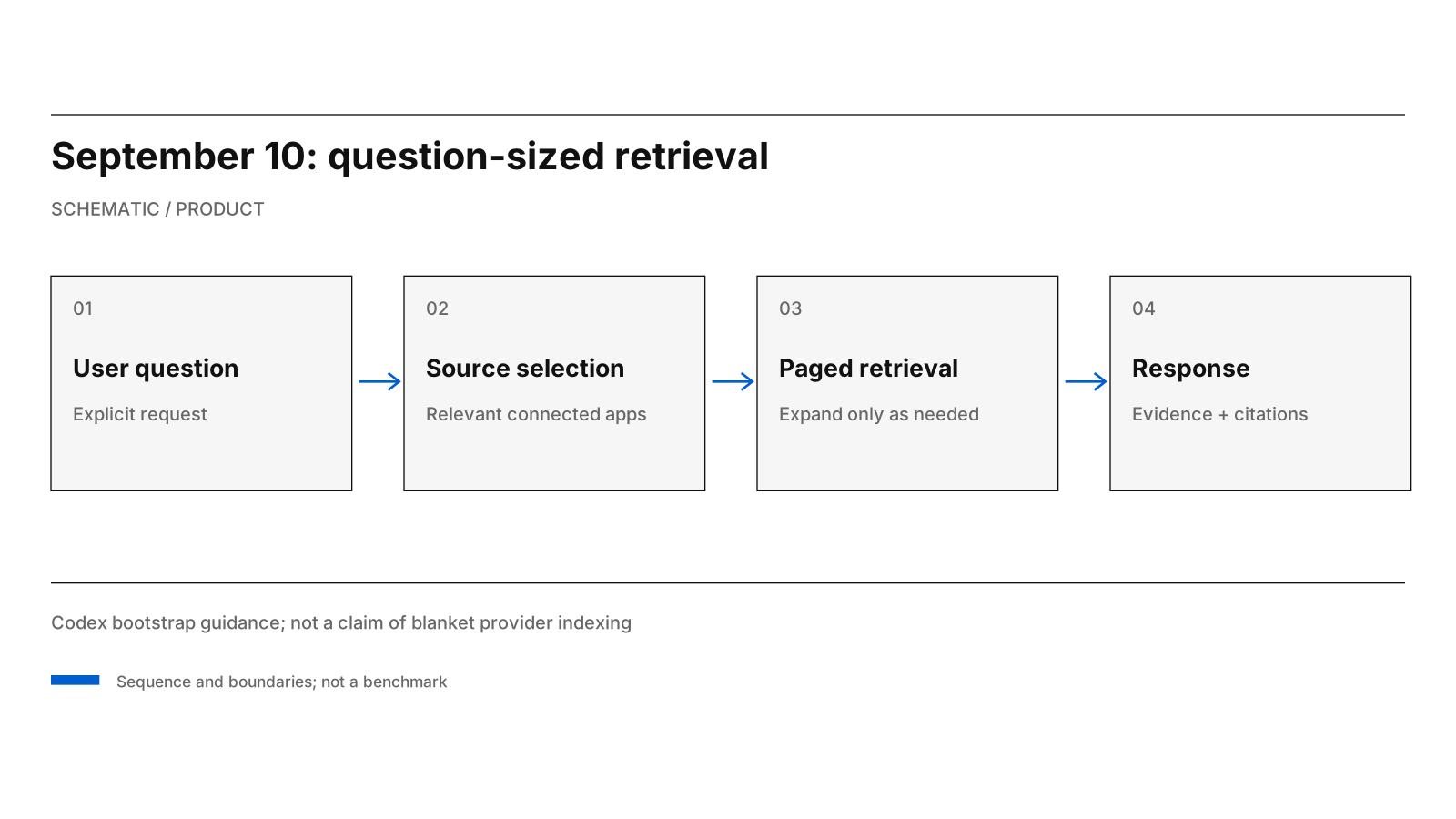
Diagram: the scoped retrieval and permission contract in the September Codex integration.
This is an editorial simplification of the retrieval contract, not a packet trace of a particular user query.
The plugin tells Codex to begin with a question-sized provider search batch, then grow the batch only when the evidence does not answer the question. A complete collection request is treated separately: the --all mode is reserved for a user who explicitly asks for completeness. An ordinary question should not trigger a scan of unrelated account data.
That rule matters even when the data never appears on screen. Reading a provider source can incur API usage, consume time, and move information through authentication and indexing boundaries. Reducing the initial search to a justified set makes both performance and privacy behavior easier to reason about.
Connection is not success
The plugin README identifies Gmail, Google Drive and Outlook as the released automatic Windows sources for that integration path. Other named sources are either in connector fabrication or outside that Windows release. The connector catalogue lists other sources separately by their development and platform support.
The onboarding path authorizes sources before content retrieval. Its documentation says the connector setup does not read messages or files simply as a side effect of onboarding. If a source returns NEEDS_ATTENTION, Codex is instructed to report the provider-specific obstacle, not paper over it with a success message.
Failures at this stage can have several meanings: an account is not authorized, a provider step requires the person, a source is not indexed or readable yet, or a connector has not established enough state to answer a question. A reliable interface should not collapse those cases into the same green check.
The plugin itself is instructions for Codex, not a container for user data, an OAuth token store, or the connector engine. Its repository explicitly describes that narrow boundary. The installed Zortex components perform connection and retrieval; the bootstrap teaches Codex when and how to use them.
Privacy boundary
For its documented Google integration, Zortex requests read-only Gmail and Drive access for authorized synchronization and analysis. The plugin privacy document says synchronized content and OAuth tokens live in encrypted local Zortex custody. A selected, cited subset may be shared with the AI provider the user chooses for an answer, subject to that provider's terms.
Question-first retrieval does not, by itself, prove that every accidental disclosure has been prevented. A mistakenly broad question, a provider integration defect or a compromised machine can still create risk. We should evaluate the actual content sent to external tools, not infer safety only from the presence of a paging parameter.
Removal is another distinct operation. Uninstalling the Codex bootstrap plugin removes its instructions. It does not erase the Zortex vault or automatically revoke provider access. The repository directs users to source-specific connection rollback for that task. Product UI should make those distinctions legible rather than hiding them behind one "disconnect" verb.
Compatibility and testing scope
The documented installation path uses Codex CLI and the @zortexhq/install package on Windows. A successful bootstrap requires the installed CLI to be current, the provider authorization to complete and the source to become readable. The plugin's progress and retrieval behavior is documented in source and commits; this article does not claim an independently executed live-provider regression run.
The source-level acceptance procedure uses a fresh supported account, a scoped question and inspection of the retrieved records. It checks missing and stale index states, the needs-attention response and the exact snippets selected for delivery.
The complete-request path deserves its own acceptance case. Asking for "everything" is materially different from a scoped question, and the interface should show the scope before broad retrieval begins.
What the user sees
The person sees a clearer distinction between a connected account, readable source and sufficient evidence. Retrieval progress stays visible, and a broad collection request remains a separate, explicit operation.
This integration illustrates the behavior we want across AI hosts: authorization once, information retrieved for a stated reason, and a response grounded in identifiable records. It is one bounded change in the development history. This retrieval contract supplies a concrete basis for bringing permission-scoped context to more AI hosts.
Source basis: ZortexHQ/zortex-codex-plugin README and PRIVACY.md; September 10 commits c9fab5d77, 3c63a64c4, f7b05ecf8 and d4715aa55. The described integration behavior is sourced to the README and code history cited above.