On this page
A conversation with an AI can be useful for an afternoon and irrelevant the next week. The underlying knowledge is different. A decision, a contact, a document and the relationship between projects remain useful even when the assistant changes.
Zortex's premise is that this continuity should belong to the person doing the work, not to whichever AI happens to be open. The desktop application organizes authorized information from connected sources into local storage and a searchable index. The same context can then support requests from different connected assistants, subject to the permissions granted to each one.
The user controls which supported sources enter the local record and which connected assistant receives a selected part of it.
Ownership has practical tests
“Your data belongs to you” is only meaningful when it leads to operations a person can understand. Can you identify where a copy is stored? Can you stop new synchronization? Can you change which assistant receives it? Can you remove the local record? Can you distinguish what remains with an original provider from what has been copied somewhere else?
The answers are not all the same operation. Google retains the original records under the user's Google account. Zortex maintains synchronized records on the device. An assistant host can receive selected results and may keep its own copies under its terms. Control over one of these locations does not automatically control the other two.
The application privacy policy draws those distinctions rather than describing ownership as a universal deletion right that all third parties automatically obey.
A local copy changes the default
With a local vault and index, finding a relevant email or project reference does not require shipping the full mailbox to each AI provider. That is an architectural advantage. It allows retrieval to happen near the data, with selected results crossing an explicit integration boundary when the user requests assistance.
The product's secret storage is also specific. OAuth secret cells are encrypted with AES-256-GCM. It would be incorrect to infer that every indexed word and synchronized document is automatically application-encrypted on every supported operating system. Users must still account for device access, operating-system encryption and their installation's configured storage locations.
Original service  <--- authorization/revocation --->  Zortex local vault
                                                          |
                                             scoped retrieval on request
                                                          |
                                                          v
                                                    AI provider copy
                                               (separate retention terms)

Control is per location; there is no universal "undo" arrow.
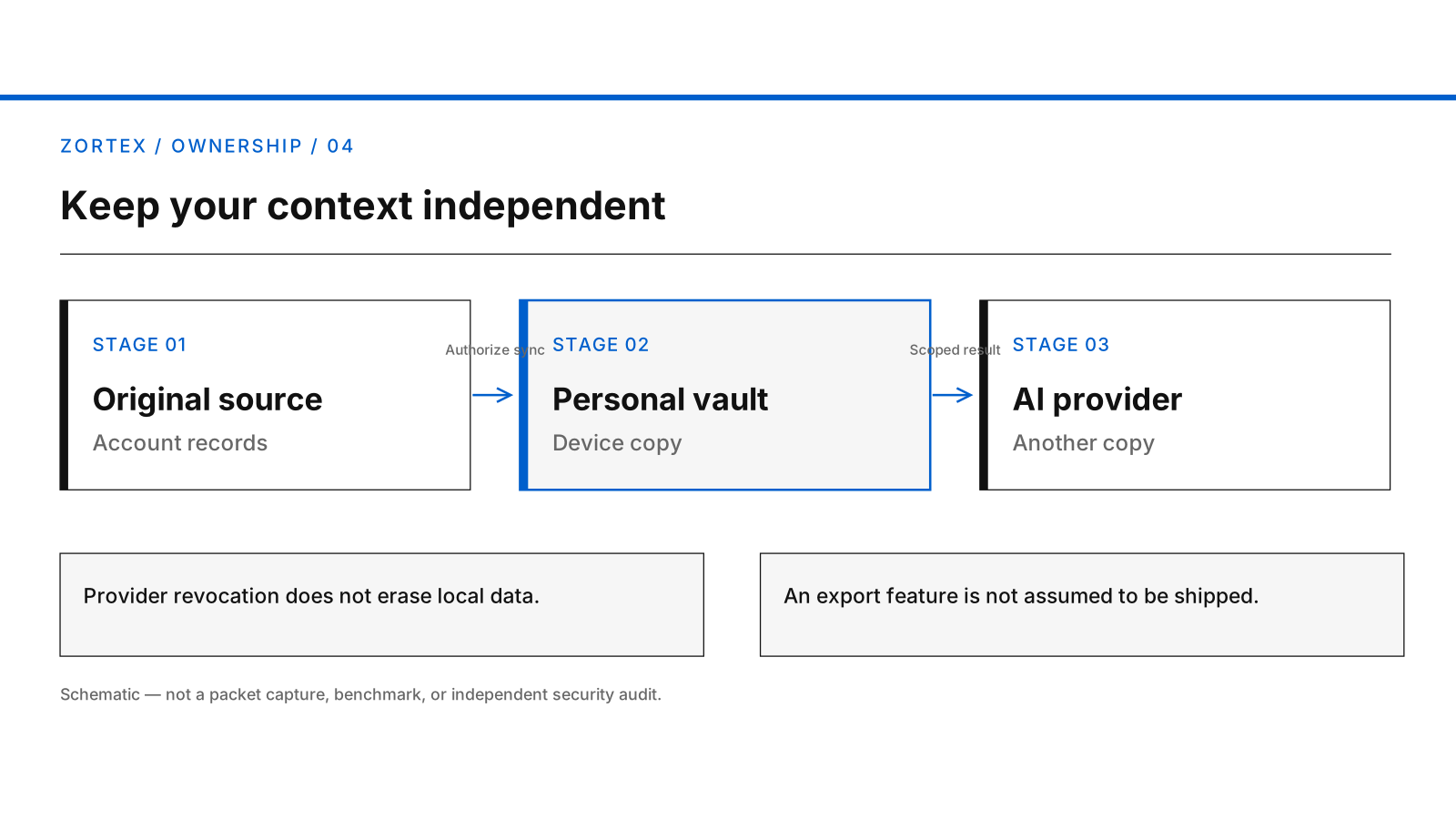
Explanatory diagram of a data-handling boundary; actual access depends on the service and permissions.
The generated geometric cover is available as a vector illustration.
Portability is more than switching chat windows
Moving between assistants should not require teaching each one an entire work history from scratch. That is the reason for separating context from the assistant in the first place. The application exposes selected context through supported integrations instead of defining the person's history as a feature of one model's chat log.
There are limits worth stating. A working source connector is not proof that every item in the source has been synchronized. Retrieval may return a summary, a reference or an excerpt, not a complete original document. Relationships inferred across sources are useful only if they remain supported by underlying records and can be corrected.
Zortex's implementation retains source identities and revisions alongside derived context. A portable record has to carry those references and permissions, not only a chat transcript or model-generated summary.
Permissions belong to relationships
It is tempting to call ownership a simple choice between local and cloud. Real control requires more dimensions. A source grant can permit retrieval from a provider; an AI-specific grant can limit paths, record kinds and content forms; a cloud-model configuration can change where selected context is processed.
The public waitlist description discusses local operation and an optional Cloud direction for access when the user's computer is off. That direction should not be read as a promise that every current installation has remote availability, or as consent to upload all content by default.
A person should be able to select an assistant because it is appropriate for the task, not because it has become the only place their context exists. The grant boundary is how that choice becomes more than a slogan.
Leaving preserves a clear record of what remains
Stopping a connector preserves previously synchronized local information. Revoking source authorization prevents future access through that authorization but does not erase what has already been copied. Deleting local data requires removing the configured storage and retained copies. Material already sent to another provider must be handled with that provider.
That separation makes exit legible: stop future provider access, inspect local copies, remove retained files and address any independently held provider data through its own controls.
The application privacy policy gives the current operating rules, deletion steps and contact at support@zortex.me for installation-specific questions.
Sources: product implementation and the application privacy policy, reviewed October 9, 2026.