On this page
A capable assistant can answer a general question without knowing you. Ask who approved a change to your customer contract, and the answer depends on a different asset: the latest document, the conversation that changed it, the right person, and which sources you may share. That asset is context. It is assembled over time, often across several products, and its errors carry a cost.
This is why comparing assistants only by model quality or subscription price leaves something out. The user also pays to reconnect data, correct assumptions and teach a new tool the history of their work. Companies that hold that history may have an advantage even when another company ships a better model. The advantage is contingent: context can be exported, retrieved on demand or moved between assistants.
Three ways to deliver 120 context requests
Consider a modeled workload of 120 context-dependent requests in a month. Assume the naive design sends the same 12,000-token context packet with every request. A compact packet sends 4,000 tokens. A selective retrieval system supplies 1,500 tokens specific to the question. We count context input only; the user's question, system instructions, tool calls and the model's answer are excluded.
| Context policy | Tokens per task | Monthly context input | Relative count |
|---|---|---|---|
| Full packet | 12,000 | 1,440,000 | ████████████████ |
| Compact packet | 4,000 | 480,000 | █████ |
| Selected evidence | 1,500 | 180,000 | ██ |
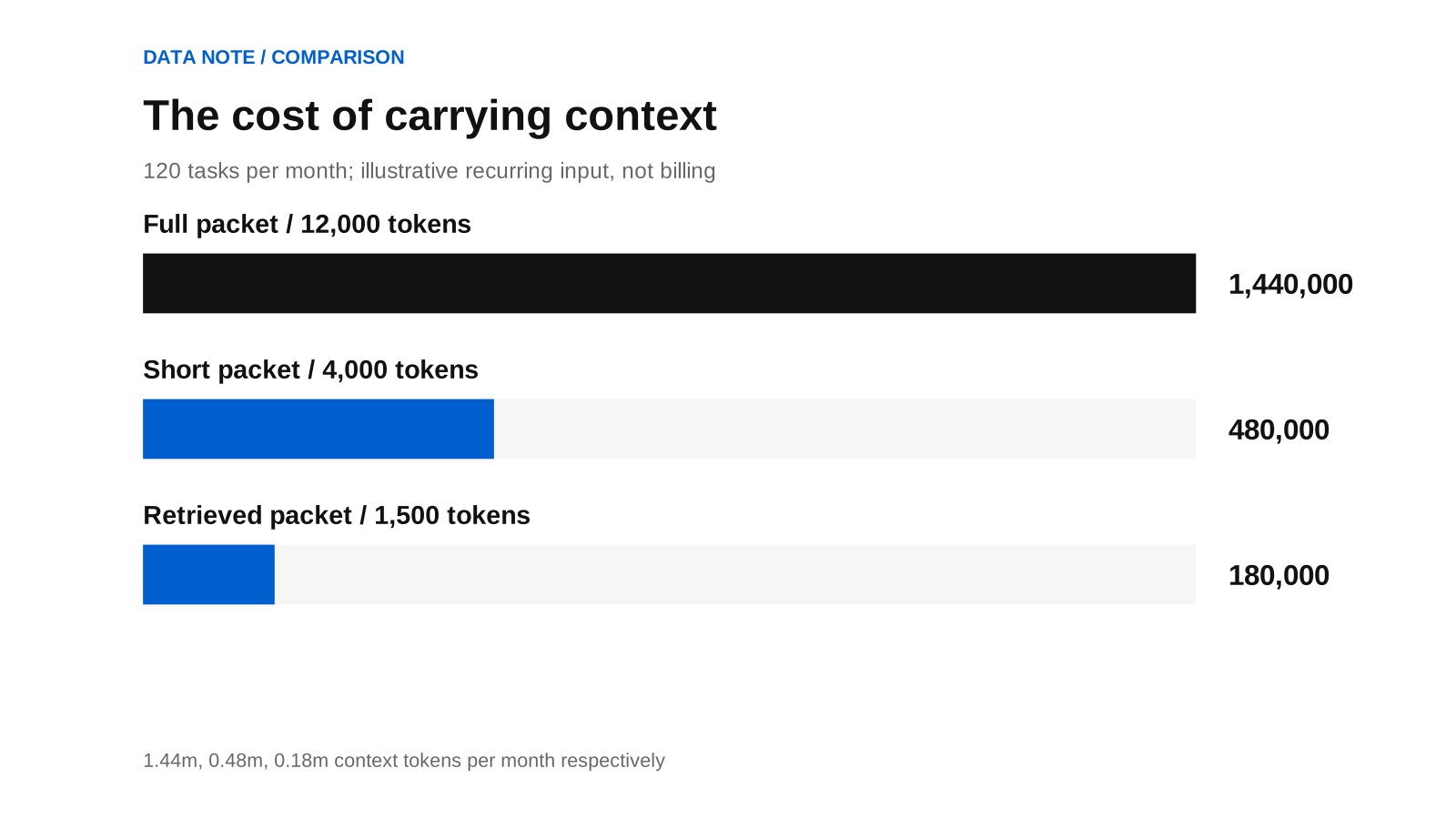
Figure: calculated monthly context token counts for three per-task context payload sizes.. The 1,500-token policy sends one eighth as much context as the 12,000-token policy: an 87.5% reduction in this measure. These totals follow from 120 modeled requests and the stated per-request token budgets. Price, latency and answer accuracy depend on caching, retrieval and the chosen model.
API billing is not a simple price per raw prompt. OpenAI's 2024 prompt-caching announcement described discounted processing for repeated prefixes, and vendors have since developed different caching rules. A long, stable prefix might be cheap to reuse in a concentrated session. Changing retrieved snippets might miss that cache. Models differ in input rates, and retrieval itself consumes storage, computation and source requests. A fair comparison prices the actual mix of cached and uncached inputs.
There is a quality condition too. Selective retrieval has to return the contract amendment rather than an earlier draft, preserve who approved it, and exclude information the assistant may not see. A system that saves 1.26 million input tokens by leaving out the decisive message is worse than the full packet. Including confidential information without permission is not optimization at any price.
Where the advantage accumulates
Three product decisions show personal context becoming a distinct part of assistant design.
OpenAI's 2025 ChatGPT Memory update expanded reference to earlier conversations. Google's January 2026 Gemini update introduced opt-in connections to selected Google apps for personalized answers. Microsoft describes Copilot memory using conversation history, work content and profile information where enabled. These are not identical products or data practices. They show vendors moving beyond a blank prompt into accumulated user-specific knowledge.
If an assistant knows that a project changed owners yesterday, it may save time on many later tasks. The value comes partly from the model's reasoning and partly from the freshness of the data it retrieves. Better models remain important; context determines whether general ability applies to the work in front of the user. This creates switching friction: repeated permission setup, incomplete exports, missing provenance and habits that cannot be represented as one memory sentence.
Friction is not permanent lock-in. Anthropic's September 2026 guidance documents importing and exporting Claude memory, including transfer from other providers. That weakens any claim that memory is universally nonportable. But transferring a summary of user preferences is not necessarily the same as transferring a continually refreshed, source-linked account of which people, decisions and files matter. Buyers should ask what survives a switch: preferences, source pointers, access controls, correction history, or only text.
Three separate bills
It helps to price context as three activities rather than one feature.
The first is construction. Accounts must be authorized, objects discovered, duplicates reconciled and relationships represented. An initial history import can be expensive even when maintenance is cheap. The second is upkeep. Deleted documents and reassigned projects require updates; access withdrawal must invalidate information quickly. A stale index can make a fluent answer worse than no personalized answer at all. The third is delivery. Each request needs a selection policy, permission checks and enough evidence for an assistant to answer. Sending less data at this stage does not erase the first two bills.
Who pays depends on architecture. A platform may build and keep context within its own product. A company may maintain central retrieval. A local-first application may keep most of the state on a person's device, sharing a bounded part with each selected assistant. These models trade hosting expense, device availability, integration effort and operational control differently. None is always cheapest.
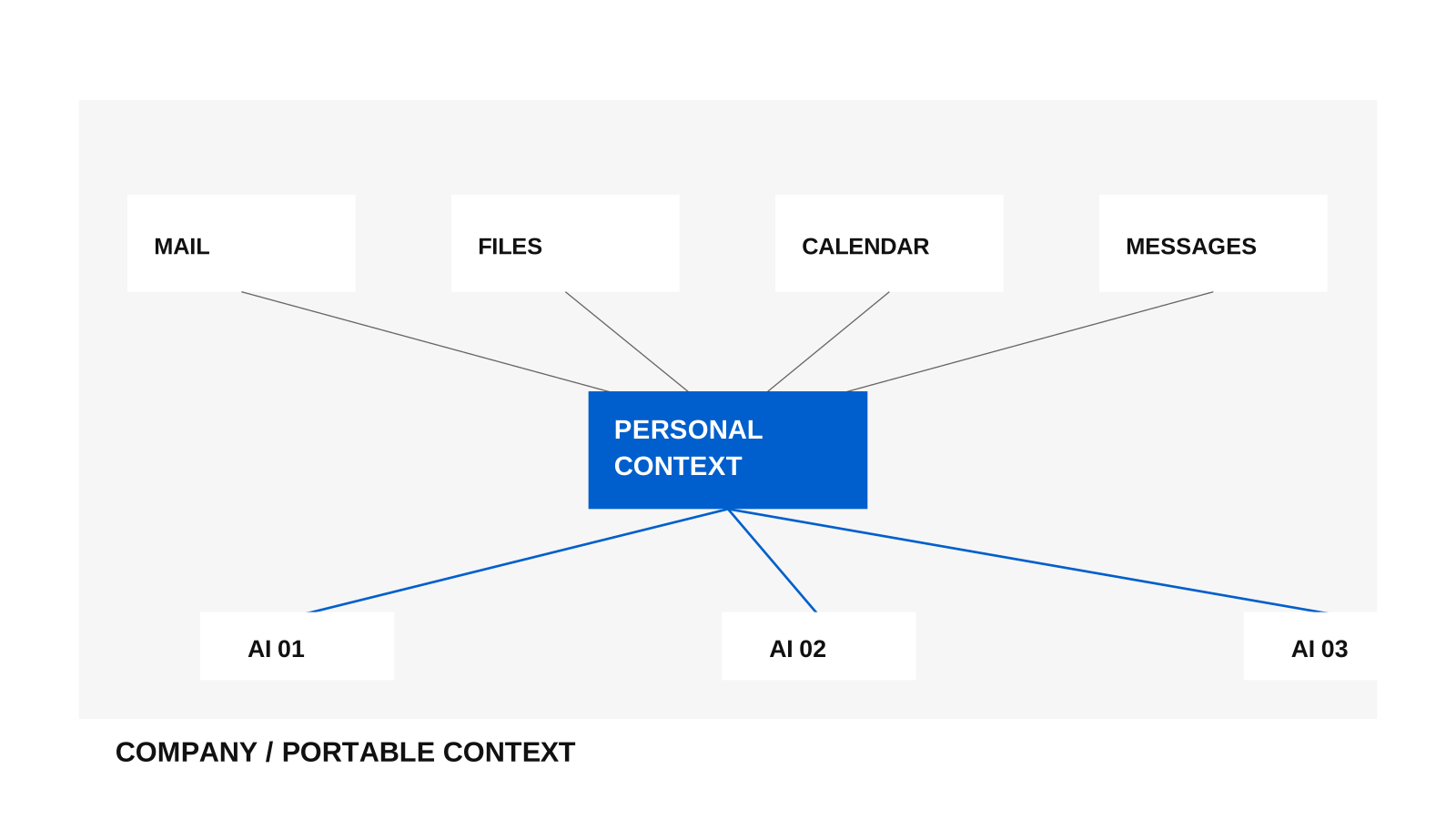
Zortex's early-access description sets out the third approach: a Windows and macOS app intended to link work sources into a personal world model, keep it local by default, and let the person decide what each AI can access. The page also describes optional cloud access when the computer is off. That is a product plan, not demonstrated market share or audited savings. Its economics should meet the same standard as competing designs.
What makes context worth carrying
An evaluation could hold the worker's questions and source permissions constant, then compare assistants on answer accuracy, source freshness, forbidden-data exposure, time to reconnect a new assistant and end-to-end cost. It should include difficult tasks after a provider switch. Token totals reveal possible waste; they cannot establish the value of the evidence.
The useful question is whether a person can correct the record once, control each handoff and keep source-linked context when changing models. Context only reduces repeated work when it stays current, is authorized for the receiving assistant and contains the evidence required by the task.
Source and figure note
The vector figure and cover composition are reproducible from the chart generator. The figures calculate context-token volume from stated inputs; vendor prices and usage statistics are cited separately. Vendor details are attributed to linked documentation; the competitive interpretation is ours.