On this page
A release note earns its place by identifying the code that changed, the behavior it exercises and the result somebody else can inspect. The most useful records include the failure that prompted the change.
Working in the open, for Zortex, means publishing useful explanations of decisions and trade-offs. It does not mean every repository, development environment or user record is publicly accessible. Some of our implementation repositories are private. We should say so rather than imply that a public article provides independent access to code it does not expose.
The object of the exercise is not maximum disclosure. It is a record that can survive a change of team member, tool or assumption.
Start with a claim narrow enough to test
A good release note names a change and the system in which it was observed. There is a difference between "a wrapper is shared across two hosts" and "every desktop UI now behaves identically." The first can be established by examining the shared asset service, host plugin and installer in a particular build. The second would require considerably more testing across versions, machines, permissions and native controls.
The same discipline applies to the website. Its content source is Markdown and YAML frontmatter in the repository. A seed command reconciles these files into the publishing database. Drafts and published versions are separate, and a private revision is not supposed to appear publicly until publication. That is a meaningful behavior to test.
A screenshot cannot demonstrate that boundary. A test needs to save a draft, publish it, modify the private working version and check that an anonymous reader still sees the previous publication. This is why we treat a check as an argument with explicit preconditions, not as a certificate of overall quality.
Keep the counterexample
Our website verification record contains cases where things first failed. An editor save remained marked dirty because two equivalent JSON objects serialized their keys in different orders. The correction was to track an edit version, so keystrokes made during an in-flight save stay unsaved.
Another failure came from long, unbroken editorial text. Brand names, titles and metadata escaped intrinsic layout constraints at narrow widths. The fix included explicit minimum-width behavior and emergency wrapping. Code and tables retain their own scrolling; hiding overflow on the whole document would only conceal the defect.
Neither example is glamorous. Both have durable value. The next person working on an editor or a responsive card can understand why a rule exists, rather than copying a visual patch and removing it later.
Our preferred evidence chain looks like this:
Observed problem
       |
       v
Reproducible case
       |
       v
Correction + executed checks
       |
       v
Written result + evidence boundary
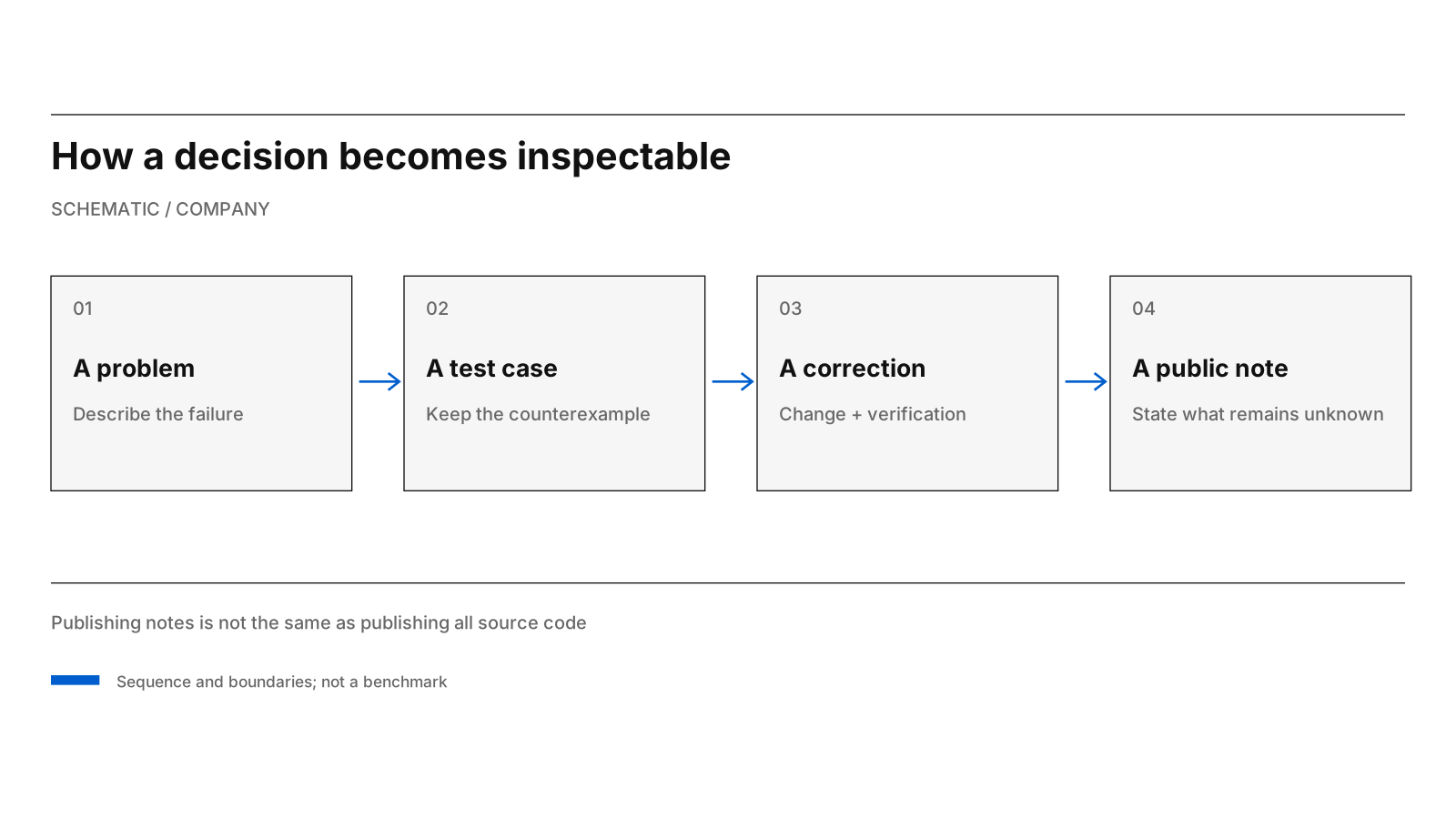
Conceptual illustration of design principles, not a certification of a live integration.
What the browser checks exercised
On September 16, the website's verification record described an executed native Playwright run on macOS with a disposable database, real local server, cookies, sign-in, editing and publication. It also recorded earlier browser checks using a bridge, because Chromium in that particular environment could not navigate even to localhost.
Those are materially different methods. The bridged tests could exercise DOM behavior and genuine server requests; they could not establish ordinary browser navigation, native cookie behavior or TLS. The later native run covered a different, narrower claim: a local browser workflow passed on that machine. It did not establish production uptime or cross-platform equivalence.
The same document preserves laboratory Lighthouse measurements alongside their conditions. Simulated throttling on one machine is not a field performance guarantee. A result without the setup and scope would invite a stronger conclusion than the evidence supports.
We publish the environment and operation beside the result. Native browsing, bridged DOM tests and laboratory performance measurements answer different engineering questions.
A source of truth for editorial work
There is a practical reason to write alongside the implementation. Our site reads posts from versioned files, and its editor has a private draft / public publication boundary. The Markdown source carries title, date, category, summary, images and article content together.
That lets a future editor inspect which words and assets belonged to a change. It does not automatically guarantee that a page is correct. Editorial review checks the content, verifies asset paths and connects factual claims to their sources. The repository is a convenient place to store evidence; the evidence does not appear merely because a commit exists.
Our publication records name the source of every value shown in the interface.
What remains private, and why
Authentication material, local vault records, live customer data and machine-specific measurements do not belong in a public explanation simply because they could make an article more vivid. A report can state that a process was tested without copying the user's files into a screenshot or publishing a credential-bearing log.
We also do not equate public writing with a security audit. A system card or architecture note can describe the control model and failed cases. It cannot replace an independent evaluation of the full deployed product.
Our standard should be: publish the decision, the relevant mechanism, the outcome and the remaining unknown; withhold private data; avoid implying that unreleased plans have already reached users.
The useful end state
Open work is useful when somebody outside the original implementation team can ask a specific, productive question. Which build did this test? Was that a simulated connector or a live provider? What happens after a failed authorization? Can the change be rolled back? What would falsify the article's main conclusion?
If a note cannot answer those questions, it may still be a useful sketch. It should be labeled as a sketch. If it can, it becomes a durable part of the product's history.
Source basis: ZortexHQ/zortex-site, docs/TESTING.md (September 16 record), app/content.py, app/markdown.py and app/schemas.py.